- Home
- Clinical Disciplines
- Prosthetics & functional rehabilitation
Prosthetics & functional rehabilitation
Restoration of aesthetics, function, occlusion, vertical dimension, and long-term stability.
At Laser Dental Clinic, prosthodontic treatment is not regarded as the isolated fabrication of a crown, bridge or denture. It forms part of the comprehensive rehabilitation of the masticatory system and is planned after assessment of biological health, supporting teeth and tissues, occlusion, function, aesthetics and long-term maintainability.
In complex cases, definitive prosthetic treatment is the final restorative stage after the necessary periodontal, restorative, endodontic, surgical, orthodontic and functional preparation.
1. Comprehensive Diagnostics and Pre-Prosthetic Planning
Before definitive prosthetic treatment, we assess the diagnosis and prognosis of each supporting tooth, periodontal condition, available bone and soft tissues, inter-dental spaces, occlusion and functional loading. When required, the diagnostic process may include photographic documentation, digital impressions/intraoral scanning, radiographic examinations, diagnostic models and functional assessments.
The final restoration is planned before irreversible treatment stages whenever possible, so that individual procedures contribute to one common functional and aesthetic objective.
2. Biological Stabilisation Before Prosthetic Treatment
Definitive prosthetic restorations are planned on a stable biological foundation. When indicated, caries and infection control, endodontic treatment, periodontal stabilisation, professional oral hygiene, surgical preparation or orthodontic preparation are completed beforehand.
The objective is for prosthodontics not to conceal an active problem, but to restore an already stabilised system.
3. Occlusal and Functional Analysis
For single restorations, and particularly for complex rehabilitation, we assess tooth contacts, load distribution, mandibular movements, the masticatory muscles and the temporomandibular joints.
- clinical occlusal registration and control;
- repeated occlusal registrations when required;
- Teethan EMG when functionally indicated;
- TMJ and muscular-balance assessment;
- selective functional equilibration when clinically justified.
Functional assessments complement the clinical diagnosis and are interpreted within the context of the individual case.
4. Pre-Prosthetic Orthodontics
When tooth position, inclination or spatial relationships do not permit an optimal restoration, limited or comprehensive orthodontic preparation may be recommended before prosthetic treatment.
This allows the required space and tooth position to be created through controlled movement rather than compensating for unfavourable relationships solely by tooth preparation or excessively contoured restorations.
5. Minimally Invasive and Partial Restorations
When the remaining healthy tooth structure and clinical conditions permit, a tissue-preserving approach is preferred. Depending on the indication, indirect partial restorations, inlays, onlays, overlays and other adhesive solutions may be used.
The choice between direct restoration, partial coverage and full coverage is based on the remaining tooth structure, functional load, endodontic status, aesthetic requirements and prognosis.
6. Crowns and Fixed Bridges
When full coverage or replacement of missing teeth is required, individually planned crowns and fixed bridges may be fabricated.
- zirconia restorations – monolithic or aesthetically layered according to the indication;
- metal-ceramic restorations in appropriate clinical situations;
- other materials and designs according to the functional and aesthetic requirements.
Material selection is not based on aesthetics alone. Tooth position, available space, support, occlusal load, parafunction and long-term maintainability are also considered.
7. Provisional and Long-Term Provisional Restorations
Provisional restorations are a diagnostic and therapeutic stage, not merely a temporary aesthetic replacement. They may protect prepared tissues, shape soft tissues and allow evaluation of aesthetics, vertical relationships, speech, occlusion and adaptation.
In complex rehabilitation, long-term provisional restorations allow functional assessment and modification before definitive treatment.
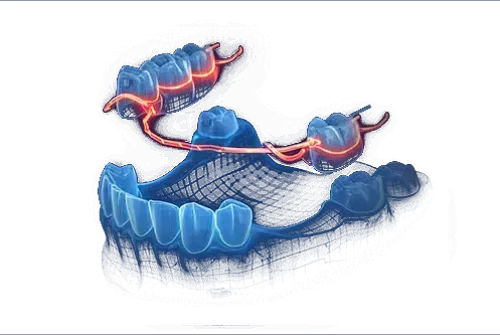
8. Partial and Complete Removable Prosthodontics
In partial or complete tooth loss, removable restorations are planned according to anatomical conditions, remaining supporting teeth, periodontal status, occlusion and the patient's ability to adapt and maintain hygiene.
- removable partial dentures and cast-framework partial dentures when indicated;
- complete dentures;
- combined solutions using precision retention elements;
- implant-assisted removable restorations when appropriate.
9. Combined Restorations and Attachment Systems
In selected clinical situations, fixed and removable components may be combined using precision retention systems, attachments, bar-retained or telescopic solutions.
Such restorations require advance planning of abutments, periodontal prognosis, path of insertion, available space, hygiene access and future serviceability.
10. Implant-Supported Prosthetic Rehabilitation
Prosthetic planning begins before surgical implant placement. Implant position and number are coordinated with the future restoration, available bone and soft tissues, occlusion, functional loading and the ability to maintain effective hygiene.
Following implant integration, treatment may include single crowns, fixed bridges, complex fixed rehabilitation or implant-assisted removable restorations according to the individual case.
11. Comprehensive Functional Rehabilitation
In patients with a severely worn dentition, multiple missing or compromised teeth, disturbed occlusion or previously uncoordinated restorations, treatment may require staged comprehensive rehabilitation.
Planning may include restoration of supporting zones, space and occlusal relationships, a trial phase with provisional restorations and functional reassessment before definitive prosthetic treatment.
We do not restore an individual tooth in isolation. We plan the restoration as part of the entire masticatory system.
12. Occlusal Splints and Functional Stabilisation
When clinically indicated, individual occlusal splints may be used as part of the diagnostic, adaptive, protective or maintenance phase. The type of splint and wearing protocol are determined by the diagnosis and treatment objective.
A splint does not replace treatment of the underlying cause and is not prescribed automatically for every patient with tooth wear, bruxism or TMJ-related symptoms.
13. Aesthetics, Function and Individuality
Shape, colour and proportions are planned in harmony with the face, smile, gingival contours, phonetics and functional requirements. The aesthetic objective is combined with biological preservation and mechanical durability.
14. Follow-up, Adaptation and Long-Term Maintenance
Delivery of the definitive restoration is not the end of treatment. Follow-up includes assessment of adaptation, occlusion, hygiene, periodontal and peri-implant tissues and functional loading.
- periodic clinical reviews;
- professional oral hygiene and an individual maintenance programme;
- monitoring of occlusion and restorations;
- functional reassessment when indicated;
- timely adjustment when changes are detected.
Clinical Algorithm
Diagnosis → biological stabilisation → functional and occlusal planning → orthodontic/surgical preparation when required → provisional and diagnostic phase → reassessment → definitive prosthetic rehabilitation → functional control → long-term maintenance.
Our Principle
The minimum necessary intervention, maximum preservation of natural tissues, and a prosthetic solution planned for the whole patient rather than for an isolated tooth.
Our Goal
A biologically stable, functionally balanced, aesthetic and maintainable long-term rehabilitation.