- Home
- Knowledge & Research Center
- Scientific Articles
- Goodbye Dental Implants? The Science Behind Growing New Teeth
Goodbye Dental Implants? The Science Behind Growing New Teeth
Scientific educational article
Third Dentition — Between Science and Hope
“Goodbye, implants!” Claims like this travel quickly on social media, accompanied by striking digital animations. Behind the sensational framing lies genuine research into dental tissue regeneration and the possibility of forming new teeth. Yet repairing pulp or periodontal tissues is fundamentally different from growing a complete functional tooth.
As of November 2026, predictable whole-tooth regeneration is not an established or routinely available human treatment. The three approaches below are promising but remain at different stages of development.
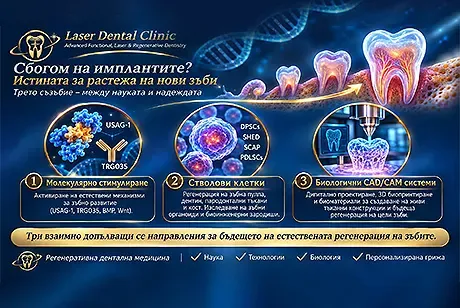
1. Molecular stimulation — USAG-1 and TRG035
USAG-1 (SOSTDC1) is involved in regulating pathways that contribute to tooth development. In 2021, an animal study showed that antibodies against USAG-1 could influence tooth formation by modulating BMP signalling [1]. These preclinical findings demonstrate biological potential, not established clinical efficacy in humans.
TRG035 is an investigational monoclonal antibody developed by Japan-based Toregem BioPharma, initially targeting certain forms of congenital tooth agenesis. Its Phase I trial was registered in 2024, with safety as the primary outcome and pharmacokinetic outcomes assessed secondarily [2]. On 17 August 2026, the company announced that Japan’s PMDA had completed the required investigation of the notification for a planned Phase IIa trial [3]. This was not marketing approval or proof that the drug regrows lost teeth in people.
2. Stem cells and regeneration of dental tissues
Research includes dental pulp stem cells (DPSCs), stem cells from exfoliated deciduous teeth (SHED), stem cells from the apical papilla (SCAP), and periodontal ligament stem cells (PDLSCs). These populations are investigated for regeneration of pulp-like tissues, dentin, periodontal tissues and alveolar bone.
Early human clinical studies have shown encouraging but limited results. A five-patient pilot study published in 2017 investigated autologous dental pulp stem-cell transplantation [4]. A 2018 study investigated dental pulp regeneration using stem cells from deciduous teeth [5]. These studies do not establish routine regeneration of a complete tooth.
3. Biological CAD/CAM systems and 3D bioprinting
Emerging biofabrication approaches combine computer-aided design (CAD), computer-aided manufacturing (CAM), biomaterial scaffolds, bioinks, living cells and tissue engineering. Unlike conventional restorative CAD/CAM, which manufactures prostheses, biofabrication aims to organise living components into patient-specific structures [6, 7].
Biological CAD/CAM is best understood as an enabling technological platform rather than an independent biological mechanism. Most dental tissue bioprinting evidence remains preclinical, and barriers include vascularisation, innervation, mechanical integration, reproducibility and regulation [7].
4. Three complementary routes
- Molecular signalling — investigating pathways that regulate tooth formation.
- Stem cell-based approaches — pursuing repair and regeneration of individual dental and supporting tissues.
- Digital biofabrication — guiding the three-dimensional organisation of cells and biomaterials.
A whole functional human tooth requires coordinated development of enamel, dentin, pulp, root structures, periodontal attachment, blood supply and innervation, along with functional integration into the jaw. This remains a major translational challenge [6].
5. Does this mean the end of dental implants?
No. As of 14 November 2026, complete biological tooth regeneration is not an established, predictable substitute for dental implants in patients with acquired tooth loss. Implants, bridges and removable prostheses remain important options according to clinical indications. Necessary dental care should not be delayed on the basis of viral claims.
6. Laser Dental Clinic’s perspective
Laser Dental Clinic follows developments in regenerative medicine, dental stem-cell research, molecular strategies and digital biofabrication. Through “Third Dentition — Between Science and Hope,” we will distinguish experimental findings from clinically established methods, with particular attention to patient safety, effectiveness and long-term function.
“Sustainable health is harmony, balance, and synchronicity.”
This article is for educational purposes and does not constitute individual medical advice.
Verifiable references
- Murashima-Suginami A. et al. Anti–USAG-1 therapy for tooth regeneration through enhanced BMP signaling. Science Advances (2021). https://doi.org/10.1126/sciadv.abf1798
- Japan Registry of Clinical Trials. jRCT2051240154: Phase I Single-Administration Study of TRG035 in Healthy Adults. Recruitment status: complete. https://rctportal.mhlw.go.jp/en/detail?trial_id=jRCT2051240154
- Toregem BioPharma. Announcement on completion of PMDA investigation of the TRG035 Phase IIa clinical trial notification, 17 Aug 2026. https://toregem.co.jp/archives/9765
- Nakashima M. et al. Pulp regeneration by transplantation of dental pulp stem cells in pulpitis: a pilot clinical study. Stem Cell Research & Therapy (2017). https://doi.org/10.1186/s13287-017-0506-5
- Xuan K. et al. Deciduous autologous tooth stem cells regenerate dental pulp after implantation into injured teeth. Science Translational Medicine (2018). https://doi.org/10.1126/scitranslmed.aaf3227
- Jin Z. et al. Stem cell-driven biomedical technologies for tooth regeneration: engineering scaffolds, organoid models, and molecular targeted strategies. Stem Cell Research & Therapy (2026). https://doi.org/10.1186/s13287-026-05044-y
- Advances in 3D Bioprinting for Dental, Oral, and Craniofacial Regenerative Medicine. Journal of Functional Biomaterials (2026). https://doi.org/10.3390/jfb17110543